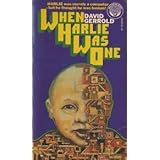
I'm not ashamed to say I picked this book up when I went on a
shopping spree for sci-fi nominees that began with "The Man." 'The Man
who Folded Himself,' 'The Man who Melted,' 'The Whole Man,' that sort
of thing. I didn't really know what I was getting into and was
completely blown away by how good it was. There are a lot of bad novels
out there about time travel, and a lot more that sort of dodge out of
the way of how complex things should get if you're having a character
jump back and forth through time, and 'The Man who Folded Himself is
neither of those things. Gerrold jumps right in from the get go, and
and the novel really devolves in to a sort of entropic level of
complexity before sort of coming back right before the end.
I'm not ashamed to say I picked this book up when I went on a
shopping spree for sci-fi nominees that began with "The Man." 'The Man
who Folded Himself,' 'The Man who Melted,' 'The Whole Man,' that sort
of thing. I didn't really know what I was getting into and was
completely blown away by how good it was. There are a lot of bad novels
out there about time travel, and a lot more that sort of dodge out of
the way of how complex things should get if you're having a character
jump back and forth through time, and 'The Man who Folded Himself is
neither of those things. Gerrold jumps right in from the get go, and
and the novel really devolves in to a sort of entropic level of
complexity before sort of coming back right before the end.
Gerrold
really embraces the idea that a paradox is possible, allowing for
multiple and alternate universes. His novel is jam packed with
different versions of the same character throughout his life. The novel
wastes no time explaining how time travel works, the protagonist is
given a belt that will take him through time on page one, and by page
two himself from one day in the future has showed up ready to guide him
through his first tour of time travel. Easily skipping the question of
what sort of time travel book this will be Gerrold has his character
intentionally make changes from what his predecessor did, letting the
reader know that paradoxes are possible in this universe, and that
multiple realities will allow alternate versions of our character to
interact with each other.
Our character moves on to
inhabit a house full of basically himself throughout different times in
his life, all interacting in different ways. The novel tracks the
character's interactions from the time he turns eighteen (all iterations
of the character agree not to interfere with their life before he
becomes an adult, allowing for the denouement at the end) all the way
until his death. The character progresses through all the stages of
life, and in a nod to the new wave of science fiction even has a
homosexual relationship with himself, sexual experimentation is kind of a
hallmark of writing coming out of this time period, but I really love
this one as it's still able to shock people today. The real heart of
the novel occurs when the main character is able to track down an
alternate reality version of himself that is a woman and have a
relationship with her, through his pride the relationship fails. In
perhaps the most touching and frightening moment of the novel he tries
to track her down later, but every place he looks she has already been
frightened away by an older and more lecherous version of himself. Good
stuff.
In classic sci-fi time travel fashion the
novel ends in a recursive loop, but optimism arises as we are reading a
log of our character's adventures which he has been filling out the
entire time, he hands this off to his younger self in the hopes that he
will use it to make better choices. Having established that alterations
of the time-line are possible the reader is left wondering what our
character would have done different had he known how it would end. It's
not really putting the end in the hands of the reader, but it's enough
to spark the imagination and really null out a lot of the more cynical
and pessimistic aspects of the novel.
This is a
complex, though short, novel that doesn't shy away from time travel, and
like I said in my post I think it was robbed of an award. Folded was
nominated for both the 1973 Nebula and 1974 Hugo award (through the
vagaries of nomination periods for the two awards) and both times lost
out to 'Rendezvous with Rama,' which is a perfectly good novel, but
compared to other books that have won both awards I find a little
lacking. Sometimes the people who hand out awards are tempted to give
them over and over to the same authors, which is one of the most
important reasons a person should focus equally on the nominees as well
as the winners. This novel pushed boundaries, and showed how complex a
novel about time travel could be, most modern time travel novels owe
this novel something of a debt, and it's a shame that it's been largely
forgotten.
Edit: It turns out that this novel is based in some parts on a Robert A. Heinlein short story called '-All You Zombies-' that I hadn't read when I wrote this review. It's little emberrasing for me to put this up here but I read that short story (it's only 19 pages) and wrote a quick review comparing the two of them. Here's my post on '-All You Zombies-.'