Books Read- 203 Books to Read-282 Percent Complete- 41.86%

Just Finished (For the third time) - 'Mirror Dance' by Lois McMaster Bujold
Showing posts with label Hugo Nominee. Show all posts

Friday, April 5, 2013

2002 Hugo Award Nominee- 'Kiln People' by David Brin

'Kiln People' has a lot going for it.  David Brin crafts a very original novel here, and adopts just the right tone to pull it off.  The concept of dittos, short term clones that can be created and absorbed by anyone,  is an interesting one, and the way in which Brin implements the concept is just as original.  While reading the novel I gave it a pretty favorable comparison to another Brin novel, 'Earth,' in that both showed the future in a positive light, rare for an SF novel.  Having completed Kiln I can say that the comparison holds true, almost to a fault.

You can't overestimate the importance of writing style and tone in SF, and pretty much any novel.  But, I think it is especially important when an author tackles a subject that's a little off the wall.  In my review for Malzburg's 'The Remaking of Sigmund Freud' I point out (correctly I think) that an improper choice of tone is what threw that novel off.  It seems an author either needs to commit fully to an offbeat premise, like Spinrad in 'The Void Captain's Tale', or let the audience in on the joke, winking at them to never take anything too seriously, think Philip K. Dick in... just about everything he wrote.  If an author is going to write something truly bizarre they need to be extra careful to keep that tone precisely where it needs to be, if you break that suspension of disbelief just one time it's gone for good and not coming back.

Brin takes the second avenue in Kiln, writing the the entire novel with a wink and nod, always letting the reader know that they're in on the joke.  There are a few laugh out loud moments in the novel, and even as the novel grows serious and finds itself a theme close to the end, Brin never lets go of the humor that he began with.  That humor can be especially helpful in the opening chapters when the reader is still scrambling to keep track of where all the Albert Morris' are, and which copies POV we are witnessing at a given time.

It can be difficult to keep track of the action in the novel.  The concept of "dittos," while amazingly original, might not lend itself easily to the written word.  There is little to differentiate between the multiple copies of Albert Morris barring the header at the start of each chapter.  This can be especially difficult in the opening chapters before the copies each begin to physically deviate from the original Albert.  I've read a few reviews by people who gave up on the novel for that very reason, while I don't agree that it's irritating enough to put the novel down, it can be off putting for the first hundred pages.

Like one of Brin's previous novels, 'Earth,' Brin explores the idea of a transparent society, and the possible future this might bring about.  It's interesting mostly because Brin imagines a world improved on our own.  It's a rare thing to see in SF of any decade, the near future novel that imagines our world getting better and not being obliterated in a fiery inferno.  While we may not like the future that Brin imagines in either Earth or Kiln, with constant surveillance, security being open sourced, and a complete lack of secrecy, it's obvious that Brin presents a future that is both more likely, and more optimistic than his fellow writers.

It's refreshing to find an SF novelist willing to believe that humanity can handle whatever problems might be on the horizon, and at the risk of comparing this novel too much with 'Earth' I'd like to include his preface from that novel, where Brin acknowledges how rare this might be:

"As writers go, I suppose I'm known as a bit of an optimist, so it seems only natural that this novel projects a future where there's a little more wisdom than folly . . . maybe a bit more hope than despair."

Kiln tackles some of the same issue as 'Earth,' but stops short of making the same wild amount of predictions as that previous novel.  Understandable considering the premise of Kiln.  It is interesting though to be welcomed back into that same optimistic future of 'Earth' considering the novels were written twelve years apart, the problem is that Kiln might follow that novel a little too closely.  The ending of 'Earth,' in which God quite literally shows up and helps our heroes win their battle, is repeated in Kiln.  While I'm more than willing to buy into an author's use of a supreme being (in the case of 'Earth' I should more likely call it "Gaea"), but I do feel like it's a well that an author can only dip in to once.  The second time around it just provokes giggles.

Brin had crafted a meticulous plot, carefully getting his characters into a tense situation, he did such a good job of drawing out the suspense that I almost would have preferred a total let down to the deus ex we receive here.  It feels as if Brin couldn't come up with an ending he felt was "big" enough for the novel, and turned again to the ending of 'Earth,' and had a supreme being show up to help win the day. 

It's difficult to write about the ending of either of these books without making it sound ridiculous, and maybe the two endings are, but they don't read too terribly insane in the context of the novel.  It's not the novelty of the ending I dislike anyway, it's the fact that Brin does it twice when I didn't feel it was necessary in the context of Kiln.  Brin was closing in on an entertaining and satisfying conclusion to Kiln without resorting to a concept he had already exploded in a previous novel.  On second thought, God showing up is a ridiculous way to end a novel, and doing it a second time isn't twice as ridiculous, it's ridiculous squared.

Nevertheless 'Kiln People' is an entertaining read, and Brin is a fantastic writer who can often be spot on with his predictions for the future.  I don't believe that's totally what he was aiming for with Kiln, as we really would be through the looking glass if I found I could transpose my soul onto a piece of clay and bake myself a clone.   But, Kiln is worth the time if only to meet Brin's cautious optimism once again, something often missed in SF.

Tuesday, March 19, 2013

1972 Hugo Award Nominee- 'Jack of Shadows' by Roger Zelazny

I came a little late to Zelazny's writing, probably because it's always at the far end of the bookstore, starting with a Z and all.  I think the first story of his I read, 'Lord of Light,' might end up being one of his best works, always a slightly depressing find when you realize an author's best work might be behind you.  I really loved Lord, and while 'Jack of Shadows' has a lot of good stuff going on it doesn't quite live up.  I read Lord last year and since then have finished 'This Immortal' and 'Isle of the Dead,' which fall into the same category as Jack, pretty good but no 'Lord of Light.'

I mentioned before how a lot of Fantasy novels (and I would classify most of Zelazny as Fantasy rather than SF, though largely I think that's a dumb distinction) inhabit a world that is largely familiar to the reader, and try to inhabit that world with original characters and tell an original story.  Zelazny in general, and 'Jack of Shadows' specifically goes against this.  It is the world itself that is unrecognizable and the characters that come off as familiar, even a little flat as in the case of Jack.  Think of Martin's 'A Song of Ice and Fire,' Jordan's 'The Wheel of Time,' or even Mieville's 'New Crobuzon' series.  There's nothing so different about the worlds those stories take place in that can't be described in a single sentence (Ice and Fire has really long winters, done), it's the characters and monsters that live in those worlds which makes the stories memorable and separates them from the world we live in. 

On the other hand 'Jack of Shadows' takes place in a world so drastically different from ours that it doesn't even begin to make sense until about fifty pages into a 200 page novel.  This is what I love about Shadows, Zelazny has gone for broke creating this universe, imagining a place where science and magic can both inhabit the same area, and in the place of the planet's core become each other's imagined fear.  This is great stuff.  But, compare the characters of those other series with the characters of Shadows and you'll come up short.  With the exception of Morningstar (probably everyone's favorite character, and the demon in the picture above) all of the characters in the novel are someone we've all encountered before in Fantasy and SF.

Even Jack's incredible powers seem commonplace now.  Though I'm not sure how they might have been viewed in the 1970's, I'm pretty sure I've seen cartoon characters that can transport themselves by shadows.  It's one of the problems of reading older fiction, you can never tell if a given trope is itself a cliche, or the original that all other cliches are based on. 

Aside from Morningstar there is Jack, who fits the mold of revenge seeking loner so neatly that I don't really need to go further into detail for you to understand him.  There is his enemy, the Lord of Bats, really a stock magician whose only shining grace is locking Jack into a 'room without doors,' another interesting piece of world building by Zelazny.  Jack's betrothed Evene is almost an afterthought as far as character development is concerned, though Jack's own manipulation of the character could be considered partly responsible for that.

The one truly great point that Zelazny makes with his characters is to send up the idea of a classic hero.  This is a bit of subversion that still feels original and fresh now forty years later.  The reader begins the novel sympathizing with Jack, we do see him killed on the first page after all.  As Jack continues on with his quest we see him do horrible things, all forgivable and most understandable, but nonetheless still horrible.  He continues on with his quest and maintains reader sympathy until somehow we arrive at an end in which Jack is undoubtedly a terrible person, beyond sympathy, completely friendless but for Morningstar. 

It's only at the end of the novel in which we realize that though Jack is surely the protagonist of this novel he can in no way be called a hero, and might even be the antagonist of the very same book.  Zelazny has a habit of creating antiheroes bound for revenge but he really outdoes himself here, and Jack's not so much bent on revenge as he is on absolute destruction of anyone who has committed the smallest slight against him.  It makes for an interesting read when you arrive at the end of the novel to find that Jack has slowly progressed from lovable antihero to despotic ruler of half a planet, and ultimately to destroyer of an entire civilization.

Normally I dislike books that end on the sort of 'Lady or the Tiger' ending that Zelazny has here, but I didn't mind it in this case.  Zelazny gives us the knowledge we need about the future of Morningstar, freed from his eternal prison by his finally seeing the sunrise, and tells us what we need about Jack's future.  Namely that he is willing to give up being a ruler, and accepts whatever might come in the new world he has created.  Zelazny lets us choose which ending we like, does Morningstar catch him or not?  Ultimately I don't think it matters though, even if Jack lives we have seen how the this world works, and Jack will forever be marred by the actions he took while in possession of the Kolwynia, no one will forgive him and he has affected everyone.  He will be a pariah on both the light and dark sides of the planet.  It does not matter if Jack lives or dies, he's made his choices and will have to live (or die) with them.

Thursday, December 13, 2012

2012 Hugo Award Nominee- 'A Dance with Dragons' by George R.R. Martin

A Dance With Dragons (A Song of Ice and Fire, #5)There are some problems that come with writing the sort of sweeping fantasy series that Martin is setting up.  One is that when you write a story that takes place across several novels you end up publishing before the story is over.  Think of the Song of Ice and Fire as one long story being published piece by piece.  By doing this Martin and all other authors of long series deprive themselves of the ability to edit as they go along.  They can't go back and rewrite a passage from the first book if they don't like how the series is going.

We tend to believe that Martin set out with the story complete in his mind, but obviously that's not true or it wouldn't take so long between novels.  The truth is more likely he had a rough outline of what would happen, but filling in the details of that outline had ramifications for the rest of the series, ramifications that couldn't be edited out or smoothed over later on. This series began as a trilogy then moved to four novels, then five and so on, now, Martin will be lucky if he can finish it in seven or eight.

The other problem with these long series is in reviewing them.  Reviewing any book in this series but the first is going to be a review of the series as a whole, which isn't even done yet.  How well Dance works as a novel can't be told until the series is finished and we are able to see it's place in the whole and how all the pieces fit together. There have been quite a few reviews of this novel to date, and some even praised Dance as a great stand-alone novel.  But that doesn't work at all.  'A Dance with Dragons' is not a starting point for a story, it's the mid-point to an ongoing series.  You can't judge the book on it's own merits, you need to view it as the part of a larger whole that it is.  That this isn't a solo novel becomes very obvious in the last few chapters, when Martin almost completely gives up on a narrative structure and begins throwing in random POV chapters for characters that only appear once, resolving some of the cliffhangers from the previous book.

It's apparent now that the outline Martin had for the first three novels was rock solid. Those clip right along and tell an exciting, well written story.  A lot of that is missing in this novel, which seems to meander for long passages with nothing happening.  Though while Dance doesn't have the solid structure or the swift pace of the original three books obviously Martin had some sort of plan for it.  A lot of what we see here in Dragons was set up in the previous books.  The amount of prophecy fulfilled in this novel alone should be proof that Martin has a plan (though more of the prophecy than I care to admit went right over my head).

The fifth (and fourth) book of this series was, by necessity, going to be a letdown.  After the heady events of the third book and the sweeping changes that came about because of them the characters were scattered.  The first book was concise, taking the characters from point A to point B efficiently, introducing us to this world and letting us know what Martin was about.  The second book built even more on that complexity, and the third book brought it all to new heights and gave us something of a conclusion.  By the start of the fourth book there were now hundreds of characters across multiple continents, few of them having any interactions with the other.  The series had reached a level of complexity that few had before.  Martin has admitted that 'A Feast for Crows' and Dragons were never intended to be part of the overall series, but that the intended time-jump just wasn't feasible.  He needed to write the two books so he could place all the characters in position for the conclusion.  The problem with Dragons is that in a thousand plus pages Martin is only able to advance each individual storyline a minuscule fraction of what he accomplished across the first three books. The reader is almost forced to ask whether that solid outline still exists and will come back to close out the series, or if Martin will do what so many other fantasy authors have done and tread water for an indefinite amount of time, generating money while he tries to figure out how to end it.

The questions then are, is Dragons the height of complexity for the series?  Where does the series go from here?  Has Dragons done it's job of placing all the characters where Martin needs them for the big close, or has the narrative completely gotten away from him?  Has Martin made so many changes to the story in the books he's published that he can no longer write what he wants?  Does he still have control over where this story is going or has he lost the thread?  Many people have complained about Dance, saying nothing happens or that Martin is beginning to repeat himself.  I know because I've been one of them.  This novel is either the setup for the endgame of the book, or it's not.

The real merit of 'Dance with Dragons' can only be understood when the series is finished.  Martin, like all epic fantasy authors, has seen fit to give us pieces of his story as he writes them.  We cannot judge the value of that story until it is complete.  We can speculate over what might happen.  We can judge each portion of the overall story as it is published, and in doing so for the first three novels will be rewarded.  'A Feast for Crows' and 'A Dance with Dragons' are similar in that when the overall story is complete they might mark the point at which George R.R. Martin lost control of his story and it got away from him, or it might be the point at which the story reaches maximum complexity before rushing to the thrilling and planned for close.  This could be simply a natural down-point for the characters and the setup for the conclusion that Martin had planned all along.  Really I wish to reserve judgement on the novel until the tale is finished, because once it's done we will be able to see Dance's place within the greater structure.  When reviewing the book now critics often talk about the series as a whole rather than the single book itself.  When the series is done they will do the same thing, only then they'll actually understand whether it's good or not.

On a more pragmatic note I think one of the reasons that this book wasn't as polished as the others in the series (most reviews cite the repetition and the need for more editing) is due to timing.  This book hit shelves seven days before the season one finale of the TV show.  You can imagine if you want that the publishers delayed putting the book out until the time was right and anticipation was high.  But, for a book that was closing in on a decade in the making, I find it much more likely that the book was rushed to meet that date.  That Martin was still working on fine tuning this massive tome when he realized it needed to be published.  I know if I were his publisher I would have told Martin to either get the book out to meet the season finale or give it up and move on.  A lot of the common complaints about the novel can be chalked up to a perfectionist constantly reworking his baby, then suddenly being rushed to completion because of financial reasons (namely, getting massively rich by releasing the book on the right day). 

So, yeah, this book has got problems.  Nothing happens, Martin spins his wheels all over the place.  He repeats himself.  People had set their sights on a real sequel, not the other half of the downer that was 'A Feast for Crows.'  But I think all I wrote above still stands, we can't judge this book until we're able to see its place within the whole.  The merits of Dance really stand with the merits of the entire series.  And while I don't see this as a book I'll ever go back and reread for fun, I'm not really willing to write it off until I see what comes next.  And I'm keeping my fingers crossed.

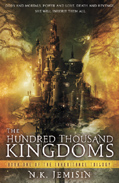
2011 Nebula and Hugo Award Nominee- 'The Hundred Thousand Kingdoms' by N.K. Jemisin

I once startled a friend by making the statement that you don't encounter a lot of  fantasy fiction written in non-western countries.  He looked at me like I was the biggest racist on the planet and asked me to support my claim.  I countered by telling him that it was just as arrogant to assume that books based loosely on the legend of King Arthur would hold as large a literary tradition in a country that cared nothing for those legends. (We were in India at the time looking at the book section so the conversation held a little more impact).

And that's my problem with fantasy novels, the legend of King Arthur.  The legend just sits there, squatting in front of whatever it is you might write.  You can't ignore the fact that it's there, you either have to write along with it, or intentionally go against it and write something to be contrary.  Do you put wizards into you fantasy novel?  If so then he's based on Merlin or he's playing against the type of Merlin.  Do you put knights into your fantasy novel?  If so then how do they fare against the round table?  Many people today will bring up Tolkein when they cite this problem, but Tolkein based quite a bit of his writing on the legend of King Arthur, so we'll start our complaint there.  I don't need to list all the books that tip the hat to either King Arthur or Tolkein, they dominate the fantasy section at your local bookstore.  It's still a very popular form of fiction, there's still quite a few books written every year that are in that direct vein, but there's not  of enough originality in the fantasy genre. 

All genres have their roots.  You can't write a mystery novel without thinking about Raymond Chandler, you can't write a space military novel without thinking 'Starship Troopers.'  Sometimes that's a good thing and sometimes that's bad.  The originals in any genre just sit there and it's up to the writers of the future to build upon the foundation they laid, or to strike out in new directions.  For fantasy in particular it's caused grief all across the genre, as far back as 1978 Michael Moorcock was saying fantasy needed to get away from what Tolkein wrote and spring in a new direction (see his essay 'Epic Pooh').  There will always be people who want to read a riff on the classics, but there needs to be more room made for those who wish to take the genre in a new direction. 

That's why it's so nice to read a book like Kingdoms.  It reminded me that this Arthur problem is only an issue with Fantasy novels written in western culture, that if you want to find a novel that is in no way based upon anything Tolkein came up with you need look no further than the next country over. As it turn out Jemisin is from Ohio, so maybe it's not as much a cultural thing as a writer thing.  So much of the genre fiction being written today is influenced by western culture, think about the genres you read, whether western, romance, or science fiction. Readers today need to strike out in a new direction every once in awhile, read something that has never been presented to them before. There are more than enough fantasy novels featuring knights, wizards, magic jewels, and enchanted swords. I want gods that turn themselves into black holes like Jemisin has here.

While Jemisin is certainly not the first writer to take a new look at fantasy, she blends enough of the mythology of other cultures into the standard sword and sorcery genre to give the reader in western culture a new look.  It seems like Jemisin completely ignored the tradition of fantasy and looked instead to the mythology of eastern culture to provide the basis for this novel.  She takes the sort of strong, modern woman character that we are familiar with and places her into a world populated with ideas fairly foreign to us, and pulls it off pretty well.

Though it takes more to make a good novel than an original idea, Jemisin delivers on all accounts.  The female lead is a strong character, well developed.  The magic in the novel is delivered in an original fashion, and taken serious.  The plot develops quickly, and the world is interesting and well developed. This was Jemisin's first novel (though she'd already won awards for her shorter fiction) and it shows.  There are a few clunky portions, and several sections where a lighter touch might have served her better.  But Jemisin is here to stay as a writer, and in Kingdoms she delivers a more than competent novel in a new and original fashion.  This novel was the first in a trilogy and I look forward to reading the rest of the series.

1973 Nebula and 1974 Hugo Award Nominee- 'The Man who Folded Himself' by David Gerrold

TheManWhoFoldedHimself(1stEd).jpgI'm not ashamed to say I picked this book up when I went on a shopping spree for sci-fi nominees that began with "The Man."  'The Man who Folded Himself,' 'The Man who Melted,' 'The Whole Man,'  that sort of thing.  I didn't really know what I was getting into and was completely blown away by how good it was.  There are a lot of bad novels out there about time travel, and a lot more that sort of dodge out of the way of how complex things should get if you're having a character jump back and forth through time, and 'The Man who Folded Himself is neither of those things.  Gerrold jumps right in from the get go, and and the novel really devolves in to a sort of entropic level of complexity before sort of coming back right before the end.

Gerrold really embraces the idea that a paradox is possible, allowing for multiple and alternate universes.  His novel is jam packed with different versions of the same character throughout his life.  The novel wastes no time explaining how time travel works, the protagonist is given a belt that will take him through time on page one, and by page two himself from one day in the future has showed up ready to guide him through his first tour of time travel.  Easily skipping the question of what sort of time travel book this will be Gerrold has his character intentionally make changes from what his predecessor did, letting the reader know that paradoxes are possible in this universe, and that multiple realities will allow alternate versions of our character to interact with each other.

Our character moves on to inhabit a house full of basically himself throughout different times in his life, all interacting in different ways.  The novel tracks the character's interactions from the time he turns eighteen (all iterations of the character agree not to interfere with their life before he becomes an adult, allowing for the denouement at the end) all the way until his death.  The character progresses through all the stages of life, and in a nod to the new wave of science fiction even has a homosexual relationship with himself, sexual experimentation is kind of a hallmark of writing coming out of this time period, but I really love this one as it's still able to shock people today.  The real heart of the novel occurs when the main character is able to track down an alternate reality version of himself that is a woman and have a relationship with her, through his pride the relationship fails.  In perhaps the most touching and frightening moment of the novel he tries to track her down later, but every place he looks she has already been frightened away by an older and more lecherous version of himself.  Good stuff.

In classic sci-fi time travel fashion the novel ends in a recursive loop, but optimism arises as we are reading a log of our character's adventures which he has been filling out the entire time, he hands this off to his younger self in the hopes that he will use it to make better choices.  Having established that alterations of the time-line are possible the reader is left wondering what our character would have done different had he known how it would end.  It's not really putting the end in the hands of the reader, but it's enough to spark the imagination and really null out a lot of the more cynical and pessimistic aspects of the novel.

This is a complex, though short, novel that doesn't shy away from time travel, and like I said in my post I think it was robbed of an award.  Folded was nominated for both the 1973 Nebula and 1974 Hugo award (through the vagaries of nomination periods for the two awards) and both times lost out to 'Rendezvous with Rama,' which is a perfectly good novel, but compared to other books that have won both awards I find a little lacking.  Sometimes the people who hand out awards are tempted to give them over and over to the same authors, which is one of the most important reasons a person should focus equally on the nominees as well as the winners.  This novel pushed boundaries, and showed how complex a novel about time travel could be, most modern time travel novels owe this novel something of a debt, and it's a shame that it's been largely forgotten.

Edit:  It turns out that this novel is based in some parts on a Robert A. Heinlein short story called '-All You Zombies-' that I hadn't read when I wrote this review.  It's little emberrasing for me to put this up here but I read that short story (it's only 19 pages) and wrote a quick review comparing the two of them.  Here's my post on '-All You Zombies-.'

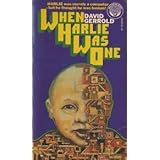
1972 Nebula Award Nominee 1973 Hugo Award Nominee- 'When HARLIE was One' by David Gerrold

Product Details'When HARLIE was One' was nominated for both a Hugo Award in 1973 and a Nebula Award in 1972, both nominations it lost to Asimov's 'The Gods Themselves.'  HARLIE suffers, like a lot of near future fiction, from being close to what the future looks like but off enough to almost make the reader giggle.  There are some jarring points early in the novel with people smoking indoors that really broke the fourth wall for me, but that's to be expected in a novel written in the seventies.  And Gerrold apparently got a few things right with his legalized marijuana (hello Colorado and Washington). I don't think this novel lives up to 'The Man who Folded Himself,' Gerrold would write that the next year, but HARLIE provides some interesting points about artificial intelligence.

This novel was definately influenced by both Heinlein's 'The Moon is a Harsh Mistress' and Clarke's '2001:A Space Odyssey.  It even mentions the second one a few times in the book, always a good sign that an author is willing to acknowledge his influences.  Remember that computers were just becoming a real thing in 1972, but it wouldn't be until 1977 that even the Apple II was released.  All the computers that come to life in these three novels have some similarities that are a little offputting today, they're all as big as a house, they all communicate basically through text, and all have cathode ray tubes or something equally ridiculous involved with them.  Gerrold does his best in HARLIE to make the technology real to life, and that might be what dates the book the worst.

All that aside, a little dating is to be expected in any novel written around this time, Gerrold uses his tale of artificial intelligence to tackle some problems that the other two do not.  Some people might be put off by the sexual aspect of the novel, or its treatment of God, but for me they were the things that breathed life into the story.  From our vantage here in 2012 it's exhausting to read another book about an AI taking over our lives, it's nice to see that even in the seventies people were looking for a new approach to the sub-genre.  Gerrold finds that new approach through HARLIE and Auberson's discussions on love.

I'm a sucker for a love story like this one, two older people both afraid of love, and also the general fear of the novel that HARLIE would be turned off in the end.  I knew going in that HARLIE would survive the novel, it would be too much like Heinlein's novel to have the computer shut off in the end.  Also I should have figured that Auberson would end up with Annie, but it's a credit to Gerrold's writing that he kept me guessing right up until the end.  I've read a few complaints about the sex scenes written in this novel, but my response is you should have known what you were getting in to when you opened the book, this is the same writer who wanted to put an AIDs story into Star Trek, as well as inter-species sex.  Not to mention the sex in 'The Man who Folded Himself.'  Graphic sex is almost a staple of sci-fi in the seventies, and it's definitely part of the New Wave of science fiction coming out at this time, and a brief glance at Nebula nominees from the 70s will show books much more interested in sex than this one.  What interests me most about this book is its exploration of love.

I found the scenes with Auberson and HARLIE discussing the definition of love very touching and subtly written.  Gerrold gives us a little foreshadowing that the machine might be a little more advanced than the man here, a little heads up for the ending so it won't come as quite the shock.  I also enjoy how there's never any talk about whether or not the computer has/can have any emotion, it is immediatelly assumed from the beginning, ruling out one more sci-fi cliche. And, the discussion between the two is actually a good one, bringing up valid points about love, affection, and lust that are still valid today.  Just imagine how shocking it would still be today if someone said that sex had to come before love.  I love how Gerrold just sort of buried that in there.

The G.O.D. machine is an interesting concept and also provides for Gerrold's little twist at the end, but other than as a plot device I really didn't find it that interesting.  I should be ecstatic over the idea of a computer that could solve any problem, and if I were in the seventies I surely would, but all the talk of printouts in cubic feet and miles of wire just sort of ruined it for me.  Sometimes a writer can get a little too into the mechanics of an idea and leave the fun of it behind, and like I said I was falling all over myself for the 'love' aspect of this novel that I really just wanted to find out how it ended to make sure they would end up together.

In the end though this novel is probably most famous for being the first use of the term 'virus' to denote a computer infection, without Gerrold we might still be calling it a 'Self Reproducing Automata.'  Though in this novel and Crichton's 'The Terminal Man' the virus is transferred through a telephone line it is remarkably similar to what we know of today as a virus on the web.  I really like this novel (someday I'm going to review a novel I don't like, I promise) and it's a good place to get in to the writing of David Gerrold for those who maybe don't like Star Trek too much, or aren't prepared for 'The Man who Folded Himself.'