Books Read- 203 Books to Read-282 Percent Complete- 41.86%

Just Finished (For the third time) - 'Mirror Dance' by Lois McMaster Bujold
Showing posts with label Nebula Nominee. Show all posts

Monday, May 6, 2013

1968 Nebula Award Nominee- 'The Masks of Time' by Robert Silverberg


It's  been quite awhile since I read this book, and while I don't intend to read it again just to write a more detailed review, I can say that the novel had a profound effect on me while growing up.  The ambiguity of the conclusion, the sexuality involved in the story, the religious (sacrilegious?) themes involved, and the hints of homosexuality might be commonplace today, but when I read it as a teenager they were all deeply shocking and eye opening. 
 
As reviewers or readers of SF we can look down on a work for being cliche or trite, but I think it's important to always remember that at one point everything was new to us as well.  So if I were to read Silverberg's 'The Masks of Time' today I don't think I would find it particularly enjoyable or groundbreaking, when I read it as a sixteen year old it was all that and more.
 
Masks was written just at the start of Silverberg's amazing run of SF Award winning novels.  I've written before about Silverberg's writing pace, but it's always worth an extra look at his bibliography, this guy was ridiculous.  Silverberg was a fairly middle of the road SF writer during the 50's and early 60's.  There were a few hints of brilliance with works like 'Thorns' (Hugo and Nebula Nominee) and 'The Man in the Maze' (No nominations) but starting in 1968 Silverberg ripped out an eight year run that produced eight Nebula and Hugo Nominated books.  This is totally unprecedented.
 
This period of Silverberg's writing starts with Masks and ends with 'Shadrach in the Furnace.'  Shadrach is a near perfect novel that stands up incredibly well today, Masks has a few faults, but you can almost see the brilliance that Silverberg was about to embark upon, and while his treatment of sensitive subjects like religion and homosexuality might inspire more giggles than introspection today, dealing with those issues in SF was unheard of then.
 
Masks deals with a rather tried SF story of a man who travels back from the future to take advantage of the past.  He leaves his origin shrouded in mystery, wrapping himself in a quasi-religious themes.  The reader is never given the full story of whether this man really is from the future, or might be God coming down to Earth.  It's just a little hard to believe that God would come down to Earth for the purpose of having sex with as many people as he could.
 
This novel contains a lot of sex.  The mysterious traveler from the future (Vornan-19 is his name, and it's been so long since I read this book that I had to look this up) basically has some sort of animal magnetism that allows him to sleep with whoever he wants, male or female, it seems no one can resist him.  This makes for an interesting scenario when some purple man from the future shows up and whisks him off.  Is everyone from the future as big a jerk as Vornan?  Is he some kind of criminal from the future?  The author never tells us.
 
I am unable to take an objective view of this book.  I think our age and mindset when we first read a book has just as much to do with our enjoyment of said book as any objective merit a story could have.  While a novel dealing with sex, homosexuality, exogenesis, and religion might be overdone in today's SF culture (I just reread that sentence and don't know if I quite believe it myself) but for a sixteen year old being exposed to most of those ideas for the first time they can be incredible.
 
As we get older it's easy to say that we take a more cynical look at the pop-culture we enjoy.  If I had read this book later in life I would have been forced to discuss this novel as an ironic send up of Heinlein's 'Stranger in a Strange Land' or even to criticize it for the things that made it impressive when I was younger.  Sometimes I find it helpful to think back on those works that got me interested in SF in the first place, but not examine them too closely.

Tuesday, March 26, 2013

1985 Nebula Award Nominee- 'The Remaking of Sigmund Freud' by Barry N. Malzburg

This book could be a prime example that our surrounding and mindset has almost as much to do with our enjoyment of a novel as the content.  'The Remaking of Sigmund Freud' has everything that an SF reader should want in a novel, originality, humor, complexity, interesting writing style, but somehow the book comes off as flat.  I'm forced to ask myself if this was just my experience in reading, as I was on vacation and this book followed several other superior novels, or is this the general experience in reading the book?

I never assumed that Sigmund Freud would make for a good protagonist in a novel, and I don't think Malzburg believed that either.  The character of Freud in the book comes off about as well as one would think he would in real life.  His internal monologue and actions are frustrating throughout the novel, kind of what you would expect if Sigmund Freud actually were to go on the sort of space adventure we see here.

You have to applaud Malzburg for originality here, no matter what else you think.  The concept of famous people from the twentieth century somehow ending up on spaceships, no matter the faulty logic involved or the convoluted reasoning behind it, is pretty awesome.  Deserving even more applause is Malzburg's choice of which twentieth century personalities to showcase in his novel.  If I were picking famous people to place on a spaceship I would probably go with Ghengis Khan, or George Patton, making it a military SF novel seems like a logical move.  Even Sir Richard Burton or some other explorer in space would make sense.  Malzburg's idea to resurrect Freud, Mark Twain, and Emily Dickenson deserves some degree of respect.  This is probably the only novel ever published that will feature these three characters on a spaceship.

The actual commentary that Malzburg is trying to make with these characters borders on the profound but is ultimately derailed by the distraction of using real life characters.  Some of the comments the author attempts to make about mental illness and the future of humanity in space are interesting, but when Sigmund Freud shows up complaining about Carl Jung the entire thing goes off the rails and any gravitas the author was attempting to bring turn into a spate of giggles.

Towards the end there is a bit of introspection regarding fame and success, and how close each of these major historical characters perhaps was to being largely forgotten by history.  Freud then trades in his entire fictional life from the book for the real life that we are aware of.  It's an interesting bit of metafiction and kind of a cool question to think about, the random choices in a life that can lead to success or failure.  But, by and large doesn't save the novel from earlier distractions.

This isn't the first book I've reviewed that attempted to take a preposterous premise and treat it seriously.  I think 'The Void Captain's Tale' wins the prize in that regard.  Whereas in Void Captain Norman Spinrad's talent as a writer was able to keep the reader grounded and suspend disbelief (stave off the giggles) for the duration of the novel, in Remaking Malzburg is not quite up to the task of making us take this story seriously the entire time.

Malzburg would have done better to emulate a writing style more like Philip Dick who even in his earlier, less ridiculous work, never seemed to take his writing too seriously and and was never scared to let the originality of his idea overshadow everything else.  Jonathan Lethem's 'Gun, with Occasional Music,' would be a modern idea of this, where the author never demands that we take the novel too seriously, and is therefore able to command our attention through a good story.

Remaking is an interesting novel that gets points for originality.  It's just what the reader should be looking for in a Nebula nominee from the early eighties.  Flawed but original, I'm sure every review for the novel was bound to say 'something new' somewhere in it, which this book definitely is.  Though 'The Remaking of Sigmund Freud' never really had a chance to win any awards, it was published in the same year as 'Ender's Game' and 'Blood Music' after all, but it's more than deserving of a nomination, and I'm glad it was.  Otherwise it might be totally forgotten by now.


Sunday, February 24, 2013

1976 Nebula Award Nominee- 'Dhalgren' by Samuel R. Delany

I have no idea how to start a review of Delany's 'Dhalgren.'  It's a difficult work, and inspires a strong reaction from almost everyone who reads it.  There's plenty of Amazon reviews for people who didn't like the novel.  Here's a Goodread's review by a man who thinks 'smart' people like it and 'dumb' people don't.  The Millions describes it as a 'Difficult Book' along the lines of Joyce's 'Ulysses' or Faulkner's 'As I Lay Dying.'  Plenty of people have things to say about 'Dhalgren,' and almost none of it actually informs us of anything about the novel.  And this review won't either.  If someone came here looking for an explanation of the novel they're not going to get it from me, and I don't believe they're going to find it anywhere else either.

I bought 'Dhalgren' on a whim, knowing nothing about it, without having read any Delany before.  I actually made it several hundred pages into the novel before realizing I was out of my depth.  I was able to recognize that there was a lot of symbolism in what I was reading, and that some of it even read like recurring themes from the author, but I couldn't attach any meaning to what I was reading about.  I set the book down and went back for more Delany.  'Dhalgren' sat on my shelf for several years while I finished 'Triton,' 'Nova,' 'The Ballad of Beta-2,' 'The Einstein Intersection,' and most of the rest of Delany's work, including 'The Jewel-Hinged Jaw,' and some of his other literary criticism.  Sort of a Delany primer so I could get familiar with the writer and his style.  And I have to say it helped.  There are a lot of recurring images in Delany's writing, the young character with one bare foot, and large overly masculine hands on an otherwise normal character both show up in several of his works.

Armed with this knowledge and a better understanding of Delany's style I went back at 'Dhalgren,' and failed.  So I tried again, and failed.  And after several more attempts at finishing it off I finally got myself in the right mindset and polished it off.  When people say that it's a difficult book they're not fooling around, both the subject matter and the writing style make this novel difficult to grab hold of.  Delany plays pretty loose with the time structure in the novel, the protagonist has blank spots in his memory early in the novel that seem to be filled in further on, though there's no indication if it actually was chronologically later. 

The edition of the novel I read had a forward written by William Gibson and I think his assessment is the best.  This novel is a question without an answer, a riddle that wasn't meant to be solved.  The novel is open-ended, and open for interpretation.  Whatever story you're looking to find inside of 'Dhalgren' is there, but if you're looking for help from the author in what to see you're not going to find it.

I have to say that I really did enjoy the novel.  I don't have any insight to offer as far as interpretation.  I think each person just has to read 'Dhalgren' for them self, find their own meaning in it.  I will say that it helps to be in the right mindset when you open the book, and this is one of those novels that almost needs to be read at a specific point in one's life.  I think I would have enjoyed this book more had I read it when I was in a more tumultuous period of my life, but as it was I did enjoy it.  I've got my own theories about some of the things that occurred in the book, and what the ending means, and I've got my own questions about the book that I'd really like someone to answer for me.  I've seriously thought about checking some college libraries to see if anyone had written their thesis on this book.  I still don't know if I'll do it.

One thing I can say about the book is it really is timeless.  This novel could have been written a year ago and it would read just the same.  Knowing it was written in the seventies might inform our opinion of the novel somewhat, but it's not as important as some other books.  It's rare to find an SF novel (if this can be called SF) from the seventies that doesn't date itself, but Delany managed to write something with equal appeal now as then.  Also, as difficult as this book is to wrap your head around you need to remember that it was a best seller, selling over a million copies when it was published.

Thursday, February 14, 2013

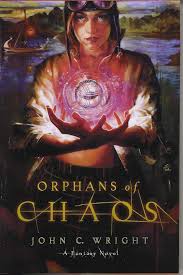
2005 Nebula Award Nominee- 'Orphans of Chaos' by John C. Wright

It can be telling sometimes when only one book out of a series is nominated for a Hugo or Nebula award.  You have to ask if maybe that one book was the one shining point in an otherwise dull series.  Maybe it was the climax of a series, where all the hard grunt work an author had put in during the previous novels paid off at the culmination.  Maybe it's like 'Harry Potter and the Goblet of Fire' and the Hugo selection panel finally bowed to overwhelming public demand, or it could be that, like Terry Pratchett's 'Going Postal' or Marion Zimmer Bradley's 'The Heritage of Hastur' nomination committees are finally giving a little recognition to some of these series that, while none of the individual works stand out are overall deserving.  The way that raises my eyebrows the most is when only the first book in a series wins or is nominated for an award, and the rest are left in the cold.  This is is the case with 'Orphans of Chaos.'

Part of a series, Orphans is followed by Fugitives and then Titans, of Chaos naturally.  The opening novel has a lot of original points, and certainly involved a lot of legwork on the part of the author.  The story involves a group of children (who are gods) that are being held hostage by another group of gods. The author goes out of his way to include almost every single Roman, Greek, and Egyptian God, as well as a few characters from Norse Mythology.  He uses some of these well known characters' original names, and brings up quite a few of the lesser known Gods as well.  It took a little research for me to figure out who 'Phobeter' or 'Alcinuous' were.  It can be a fun game to play when a new character appears to try and figure out which mythological character they are based only on Wright's description and whatever crazy name he decides to dig up and give them.

Wright sets up an interesting system of magic in the novel which deserves mention as well.  Though there are a variety of characters from different mythologies there are only four distinct styles of magic, which surprisingly do not conform to the four elements.  Each one can cancel out one other, draws against a wielder of the same magic, and fights well against the two remaining styles.  It's really quite simple compared to the type of magic you would often encounter in a similar book, and serves an important purpose sorely lacking in a lot of Fantasy novels by creating rules for the world.  Too often when an author throws magic into a book it is just that, magic, the solution to any problem.  Unless an author truly wants to show the reader that magic is capable of anything (like 'Jonathan Strange and Mr. Norell') they need a  few rules for the magic they introduce.  Too often in fantasy novels the rules of the magic aren't fully explained, allowing for the sort of Deus Ex that crops up in a lot of work (The Sword of Truth series is a good example).  Wright's system of magic works great at preventing this, the only problem being that often the magical  battles between the characters can begin to feel like an extremely complicated version of rock, paper, scissors.  Which is never good.

The Chaos Trilogy (I made that name up, the trilogy has no set name) has been compared to an 'Adult version of Harry Potter' by several reviewers, which is an apt comparison, though I will get into the 'Adult' portion of that in a minute.  The novel separates itself from the Potter books in one way by the magic system I talked about.  The Potter novels contain magic that can ostensibly do anything, often any limitations on the magic seem to arise only to serve the means of the plot.  I love Harry Potter but we have to admit that there is no concrete system to what's going on with the magic in those novels (which is fine, that's not what those novels are about).  Chaos at least is structured in such a way that the magical system stays true to itself.

This is an important point for all genre writers to remember, and especially SF writers.  A reader can buy into anything, whether it's talking trees or interstellar spaceships people will believe it, as long as the people react to it in a relatable manner and the structure of the magic (or spaceships, or tree-talk) stays true to the internal world the author has created.  You need to have a healthy suspension of disbelief to read any SF or Fantasy, and authors need to work hard to maintain it.  Staying true to the world an author creates, and obeying the rules they have set up is integral to this, and Wright does a good job. 

So, I've talked about the originality of the character even though they were ancient myths, and, I've talked about the internal integrity of the system the author uses for magic which are both good points.  The only thing left to talk about with Wright's novel is the sex, because it will make you feel dirty.  Sometimes I feel like writing instructors need to start telling potential authors that the place to air your sexual hangups is not in a mass produced novel.  I am not against sex in literature, I loved 'The Void Captain's Tale,' I made a fool of myself gushing over 'The Man Who Folded Himself,' and 'The Masks of Time' is one of the books that got me interested in SF in the first place.  I have no problem with sex in literature, it's a topic that invades our lives and needs to be explored, but it is one thing to have a ship piloted by orgasm, or a time traveler have sex with himself, and it is something completely different to have your teenage female protagonist dressed up like a schoolgirl and get aroused by being spanked in a multi-page passage of your novel. 
One of these things is not like the others.  Almost every review you read for this novel will discuss the sexual aspect of the book, if people don't like the novel that's why, if people do like the novel they find an excuse for it.  The odd thing is it's no more, and often quite less, explicit than some of those other novels I mentioned.  The character getting spanked in Orphans is a much less graphic scene than say, the oral sex scene in Void Captain, but why does it feel so much dirtier?  The problem is that the sexuality in Orphans does not contribute to the plot, which implies to the reader that it is only in the book because the author wanted to write about it.  Which makes me feel gross.  If an author has something interesting to say about sex (or something funny, or weird, or anything at all) I don't mind reading about it, if you want to tell me what gets you off then stick to literotica.

I've written before about judging a work based on it's own merits.  We should not take into account the author's personal life, political views, or other works when judging a piece of literature.  But I believe when a book is a part of a series we do need to take a look at all the books of that series to truly understand the worth of a novel, I discussed this at length in my review for 'A Dance with Dragons' (and that's the reason I'll really have to rewrite that review when the series is finished).  So, while the rest of the books in the chaos series did not receive any nominations and I won't be reviewing them here, I do believe it's important to look at the series as a whole, because they inform upon the work that was nominated.
Which brings us back to Nebula nominations.  This is the only book in the series to be nominated for any awards.  It's not the only book that this has happened to, 'To Your Scattered Bodies Go' by Farmer was the first and only novel in the Riverworld series to be nominated, and with good reason.  But, we have to take a close look at what Wright brought to the table with Orphans, and what was missing in the later installments.  He created a magical world, one in which children were finding their powers and trying to escape their omnipotent captors.  A world bound by concrete rules regarding that magic that the author was able to stick to throughout the story.  He populated that world with interesting characters, and the story he told in that world, while not necessarily the most original, was at least compelling enough for the reader to forgive him if he took a few authorial liberties into unnecessary sexual exposition.  The first novel in the series contains enough promise and originality that we can optimistically hope that the rest of the series will continue in the same direction.  That optimism is what got the book nominated, just the same as our optimism about The Expanse series is what garnered 'Leviathan Wakes' a nomination even though the series isn't complete yet.  In 'Orphans of Chaos' that optimism is never realized and completely gone by the time the series is complete.  In the wake of those series that didn't live up to the promise of their first novel you almost have to wonder if Farmer or Wright would have been better off not even completing them, leaving them unfinished with that optimism still intact.

As the series goes on the reader realizes that creating that world and that system was all that Wright brought to the table.  As the series progresses the value of the story steadily decreases, the originality of the world and magical system wears away, and the amount of sexual 'ick' steadily begins to rise.  At the end of the novel almost everything seems to revolve around placing his female protagonist into sexually questionable scenarios, with the character of Colin harassing her at every turn.  It comes to a point where the reader almost feels culpable in belittling the character, as it becomes increasingly impossible to buy into her enjoying her treatment (which is what the author would have us believe).  While the world Wright has created, and the rules he governs it by have been well thought out, it is his characters that ultimately fail the reader, that break the suspension of disbelief.

There are more than enough novels out there that belittle and victimize women.  This novel doesn't even present that victimization in a manner inspired enough to provoke discussion, only to titillate.  And that is perhaps the lowest cut of all, that to read Wright's series he asks not that we simply view the belittlement of women in his writing, but that we enjoy it.

Tuesday, February 5, 2013

1984 Nebula Award Nominee- 'The Void Captain's Tale' by Norman Spinrad

I've talked before about SF authors setting their sights a little too high, and some of the novels nominated for the Hugo or Nebula getting by more on concept than actual delivery. In my review of 'Dark Universe' I talk a little about Samuel Delany's opinion on 'story' and 'writing' and why I think he's wrong to say a novel's delivery cannot be exceeded by it's concept. I might be putting words into Delany's mouth (I had trouble finding the actual quote), but either way Void is a good example of the concept, no possible story could live up to the originality of the idea. This is a story about spaceships piloted by orgasm. Let that sink in for a second. No actual story could live up to that, could it?

 This story has a spaceship piloted by orgasm and a Captain so enthralled by a woman, so consumed by her that he is willing to sacrifice his spaceship, passengers, and himself just to give her what she wants. This book doesn't just have sex scenes in it, this book is about sex, around sex, on top of and underneath sex. There's no way to extract the sex from this novel without completely changing the story.  It's there on the first page and it's there on the last.  It's as if someone challenged Spinrad that he couldn't write a compelling novel that was intrinsically about sex and he used the nuclear option to prove them wrong.

People have found this novel offensive or distasteful, but some people have felt that way about most of the author's writing. Spinrad was a big proponent of the ‘New Wave’ SF movement going on in the 60s and 70s.  New Wave strove to intentionally push the boundaries of what could be written about in SF, going out of the way to shock readers. Not necessarily a good thing, but many of the books that were adherents of this, some almost banned at the time, are more curious than offensive now (Spinrad's most famous novel 'Bug Jack Baron' is a good example of this).  On the other hand Void Captain, which came out several years after the heyday of the New Wave, would have offended people no matter when it was written, and that's probably a good reason why it's mostly unknown.  People have been offended by books with a lot less sex than this one.
 
Long passages of the book are given over to either descriptions of sexual acts or orgasms themselves. Some of these work out better than others. One would assume that these scenes would be salacious and pandering, that the actual sex scenes in the book border on the gratuitous, but they don't.  The style and tone in which Spinrad presents the topic almost precludes any notion that this is pornographic.  The best way to describe his writing style is 'detached.'  Spinrad has the narrator maintain the tone of a captain throughout the novel.  Even as his life spirals out of control and he agrees to destroy everything he has worked for to help his mistress 'Go On' and commit a form of sexual suicide the narrator's voice never changes.
 
This style is wordy, and strange enough quite formal.  This can be off putting, and can read somewhat dated, but readers should note that this is a style Spinrad affects for this story, his other works like Jack Barron are written in a completely different tone. I think the tone of the novel does a good deal of the work in helping the story not devolve into farce or pornography, something that could have easily happens with a lesser writer.  By working so hard to keep the narrator dignified in speech throughout the novel, even as he loses all his dignity in everything else, does a lot to maintain balance in a book that gets pretty out there.
 
The style also does the work of presenting the future as an alien place, foreign to us. The characters in the story choose their own names, and any introduction between two characters begins with the sharing of names, and how each character settled upon the names they have.  Spinrad injects foreign words and phrases into the daily conversation of his characters, something he also has done in 'Child of Fortune.' It is not as distracting as it sounds, and does a lot to contribute to the tone I was talking about.

The story is interesting in that the narrator lays down the entire tale on the first page. There is no suspense regarding what will occur, only how and in what manner it will be presented. The novel begins with the captain sharing his 'name story' with the reader, followed by a quick section in which he lists the action of the novel.  Nothing is hidden, if readers were expecting some major twist or surprise from the book they will be sorely mistaken, Spinrad plays no tricks and the entire tale is there at the beginning.  It's an interesting tactic on Spinrad's part, and I thought it played to the novel's strength and originality.

This novel sits in my brain, and I cannot and probably will never be able to separate how good the story actually is from how original and fascinating I find the concept. A lot of time I read novels off the list of Hugo and Nebula nominees and find a real masterwork that has been sadly forgotten, think 'Stations of the Tide' by Swanwick. A lot of others are middle of the road SF whose authors were popular years ago, their work still worth a look but nothing to scream about. Occasionally, I'll find something like Void Captain, which defies categorization. Something truly original doesn't ever come in a form you would expect (obviously), and people rarely know how to judge it. Despite being a book over twenty years old this is still one of the most original works I've ever read. 
 
Does 'The Void Captain's Tale' set it's sights too high?  Maybe, maybe not.  Like I said, I don't know if any novel could live up to the promise and originality of that premise.  But the novel is good and gets points for being both classic and postmodern, oddly enough.  Does it strive to be shocking?  Yeah, a little, I have to admit the ending where the captain sets out to sleep with every woman on his stranded ship so as to figure who would make the best replacement pilot felt a little weird.  But if a novel this original and out there can't exist in the halls of Science Fiction then where can it?

Thursday, December 13, 2012

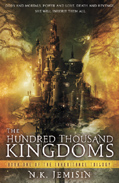
2011 Nebula and Hugo Award Nominee- 'The Hundred Thousand Kingdoms' by N.K. Jemisin

I once startled a friend by making the statement that you don't encounter a lot of  fantasy fiction written in non-western countries.  He looked at me like I was the biggest racist on the planet and asked me to support my claim.  I countered by telling him that it was just as arrogant to assume that books based loosely on the legend of King Arthur would hold as large a literary tradition in a country that cared nothing for those legends. (We were in India at the time looking at the book section so the conversation held a little more impact).

And that's my problem with fantasy novels, the legend of King Arthur.  The legend just sits there, squatting in front of whatever it is you might write.  You can't ignore the fact that it's there, you either have to write along with it, or intentionally go against it and write something to be contrary.  Do you put wizards into you fantasy novel?  If so then he's based on Merlin or he's playing against the type of Merlin.  Do you put knights into your fantasy novel?  If so then how do they fare against the round table?  Many people today will bring up Tolkein when they cite this problem, but Tolkein based quite a bit of his writing on the legend of King Arthur, so we'll start our complaint there.  I don't need to list all the books that tip the hat to either King Arthur or Tolkein, they dominate the fantasy section at your local bookstore.  It's still a very popular form of fiction, there's still quite a few books written every year that are in that direct vein, but there's not  of enough originality in the fantasy genre. 

All genres have their roots.  You can't write a mystery novel without thinking about Raymond Chandler, you can't write a space military novel without thinking 'Starship Troopers.'  Sometimes that's a good thing and sometimes that's bad.  The originals in any genre just sit there and it's up to the writers of the future to build upon the foundation they laid, or to strike out in new directions.  For fantasy in particular it's caused grief all across the genre, as far back as 1978 Michael Moorcock was saying fantasy needed to get away from what Tolkein wrote and spring in a new direction (see his essay 'Epic Pooh').  There will always be people who want to read a riff on the classics, but there needs to be more room made for those who wish to take the genre in a new direction. 

That's why it's so nice to read a book like Kingdoms.  It reminded me that this Arthur problem is only an issue with Fantasy novels written in western culture, that if you want to find a novel that is in no way based upon anything Tolkein came up with you need look no further than the next country over. As it turn out Jemisin is from Ohio, so maybe it's not as much a cultural thing as a writer thing.  So much of the genre fiction being written today is influenced by western culture, think about the genres you read, whether western, romance, or science fiction. Readers today need to strike out in a new direction every once in awhile, read something that has never been presented to them before. There are more than enough fantasy novels featuring knights, wizards, magic jewels, and enchanted swords. I want gods that turn themselves into black holes like Jemisin has here.

While Jemisin is certainly not the first writer to take a new look at fantasy, she blends enough of the mythology of other cultures into the standard sword and sorcery genre to give the reader in western culture a new look.  It seems like Jemisin completely ignored the tradition of fantasy and looked instead to the mythology of eastern culture to provide the basis for this novel.  She takes the sort of strong, modern woman character that we are familiar with and places her into a world populated with ideas fairly foreign to us, and pulls it off pretty well.

Though it takes more to make a good novel than an original idea, Jemisin delivers on all accounts.  The female lead is a strong character, well developed.  The magic in the novel is delivered in an original fashion, and taken serious.  The plot develops quickly, and the world is interesting and well developed. This was Jemisin's first novel (though she'd already won awards for her shorter fiction) and it shows.  There are a few clunky portions, and several sections where a lighter touch might have served her better.  But Jemisin is here to stay as a writer, and in Kingdoms she delivers a more than competent novel in a new and original fashion.  This novel was the first in a trilogy and I look forward to reading the rest of the series.

1973 Nebula and 1974 Hugo Award Nominee- 'The Man who Folded Himself' by David Gerrold

TheManWhoFoldedHimself(1stEd).jpgI'm not ashamed to say I picked this book up when I went on a shopping spree for sci-fi nominees that began with "The Man."  'The Man who Folded Himself,' 'The Man who Melted,' 'The Whole Man,'  that sort of thing.  I didn't really know what I was getting into and was completely blown away by how good it was.  There are a lot of bad novels out there about time travel, and a lot more that sort of dodge out of the way of how complex things should get if you're having a character jump back and forth through time, and 'The Man who Folded Himself is neither of those things.  Gerrold jumps right in from the get go, and and the novel really devolves in to a sort of entropic level of complexity before sort of coming back right before the end.

Gerrold really embraces the idea that a paradox is possible, allowing for multiple and alternate universes.  His novel is jam packed with different versions of the same character throughout his life.  The novel wastes no time explaining how time travel works, the protagonist is given a belt that will take him through time on page one, and by page two himself from one day in the future has showed up ready to guide him through his first tour of time travel.  Easily skipping the question of what sort of time travel book this will be Gerrold has his character intentionally make changes from what his predecessor did, letting the reader know that paradoxes are possible in this universe, and that multiple realities will allow alternate versions of our character to interact with each other.

Our character moves on to inhabit a house full of basically himself throughout different times in his life, all interacting in different ways.  The novel tracks the character's interactions from the time he turns eighteen (all iterations of the character agree not to interfere with their life before he becomes an adult, allowing for the denouement at the end) all the way until his death.  The character progresses through all the stages of life, and in a nod to the new wave of science fiction even has a homosexual relationship with himself, sexual experimentation is kind of a hallmark of writing coming out of this time period, but I really love this one as it's still able to shock people today.  The real heart of the novel occurs when the main character is able to track down an alternate reality version of himself that is a woman and have a relationship with her, through his pride the relationship fails.  In perhaps the most touching and frightening moment of the novel he tries to track her down later, but every place he looks she has already been frightened away by an older and more lecherous version of himself.  Good stuff.

In classic sci-fi time travel fashion the novel ends in a recursive loop, but optimism arises as we are reading a log of our character's adventures which he has been filling out the entire time, he hands this off to his younger self in the hopes that he will use it to make better choices.  Having established that alterations of the time-line are possible the reader is left wondering what our character would have done different had he known how it would end.  It's not really putting the end in the hands of the reader, but it's enough to spark the imagination and really null out a lot of the more cynical and pessimistic aspects of the novel.

This is a complex, though short, novel that doesn't shy away from time travel, and like I said in my post I think it was robbed of an award.  Folded was nominated for both the 1973 Nebula and 1974 Hugo award (through the vagaries of nomination periods for the two awards) and both times lost out to 'Rendezvous with Rama,' which is a perfectly good novel, but compared to other books that have won both awards I find a little lacking.  Sometimes the people who hand out awards are tempted to give them over and over to the same authors, which is one of the most important reasons a person should focus equally on the nominees as well as the winners.  This novel pushed boundaries, and showed how complex a novel about time travel could be, most modern time travel novels owe this novel something of a debt, and it's a shame that it's been largely forgotten.

Edit:  It turns out that this novel is based in some parts on a Robert A. Heinlein short story called '-All You Zombies-' that I hadn't read when I wrote this review.  It's little emberrasing for me to put this up here but I read that short story (it's only 19 pages) and wrote a quick review comparing the two of them.  Here's my post on '-All You Zombies-.'

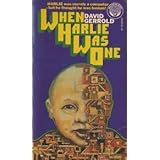
1972 Nebula Award Nominee 1973 Hugo Award Nominee- 'When HARLIE was One' by David Gerrold

Product Details'When HARLIE was One' was nominated for both a Hugo Award in 1973 and a Nebula Award in 1972, both nominations it lost to Asimov's 'The Gods Themselves.'  HARLIE suffers, like a lot of near future fiction, from being close to what the future looks like but off enough to almost make the reader giggle.  There are some jarring points early in the novel with people smoking indoors that really broke the fourth wall for me, but that's to be expected in a novel written in the seventies.  And Gerrold apparently got a few things right with his legalized marijuana (hello Colorado and Washington). I don't think this novel lives up to 'The Man who Folded Himself,' Gerrold would write that the next year, but HARLIE provides some interesting points about artificial intelligence.

This novel was definately influenced by both Heinlein's 'The Moon is a Harsh Mistress' and Clarke's '2001:A Space Odyssey.  It even mentions the second one a few times in the book, always a good sign that an author is willing to acknowledge his influences.  Remember that computers were just becoming a real thing in 1972, but it wouldn't be until 1977 that even the Apple II was released.  All the computers that come to life in these three novels have some similarities that are a little offputting today, they're all as big as a house, they all communicate basically through text, and all have cathode ray tubes or something equally ridiculous involved with them.  Gerrold does his best in HARLIE to make the technology real to life, and that might be what dates the book the worst.

All that aside, a little dating is to be expected in any novel written around this time, Gerrold uses his tale of artificial intelligence to tackle some problems that the other two do not.  Some people might be put off by the sexual aspect of the novel, or its treatment of God, but for me they were the things that breathed life into the story.  From our vantage here in 2012 it's exhausting to read another book about an AI taking over our lives, it's nice to see that even in the seventies people were looking for a new approach to the sub-genre.  Gerrold finds that new approach through HARLIE and Auberson's discussions on love.

I'm a sucker for a love story like this one, two older people both afraid of love, and also the general fear of the novel that HARLIE would be turned off in the end.  I knew going in that HARLIE would survive the novel, it would be too much like Heinlein's novel to have the computer shut off in the end.  Also I should have figured that Auberson would end up with Annie, but it's a credit to Gerrold's writing that he kept me guessing right up until the end.  I've read a few complaints about the sex scenes written in this novel, but my response is you should have known what you were getting in to when you opened the book, this is the same writer who wanted to put an AIDs story into Star Trek, as well as inter-species sex.  Not to mention the sex in 'The Man who Folded Himself.'  Graphic sex is almost a staple of sci-fi in the seventies, and it's definitely part of the New Wave of science fiction coming out at this time, and a brief glance at Nebula nominees from the 70s will show books much more interested in sex than this one.  What interests me most about this book is its exploration of love.

I found the scenes with Auberson and HARLIE discussing the definition of love very touching and subtly written.  Gerrold gives us a little foreshadowing that the machine might be a little more advanced than the man here, a little heads up for the ending so it won't come as quite the shock.  I also enjoy how there's never any talk about whether or not the computer has/can have any emotion, it is immediatelly assumed from the beginning, ruling out one more sci-fi cliche. And, the discussion between the two is actually a good one, bringing up valid points about love, affection, and lust that are still valid today.  Just imagine how shocking it would still be today if someone said that sex had to come before love.  I love how Gerrold just sort of buried that in there.

The G.O.D. machine is an interesting concept and also provides for Gerrold's little twist at the end, but other than as a plot device I really didn't find it that interesting.  I should be ecstatic over the idea of a computer that could solve any problem, and if I were in the seventies I surely would, but all the talk of printouts in cubic feet and miles of wire just sort of ruined it for me.  Sometimes a writer can get a little too into the mechanics of an idea and leave the fun of it behind, and like I said I was falling all over myself for the 'love' aspect of this novel that I really just wanted to find out how it ended to make sure they would end up together.

In the end though this novel is probably most famous for being the first use of the term 'virus' to denote a computer infection, without Gerrold we might still be calling it a 'Self Reproducing Automata.'  Though in this novel and Crichton's 'The Terminal Man' the virus is transferred through a telephone line it is remarkably similar to what we know of today as a virus on the web.  I really like this novel (someday I'm going to review a novel I don't like, I promise) and it's a good place to get in to the writing of David Gerrold for those who maybe don't like Star Trek too much, or aren't prepared for 'The Man who Folded Himself.'